AI Fitness Trainer
A privacy-first, locally-run AI fitness coach combining YOLOv11 pose estimation with a vision-language model for real-time rep counting, form analysis, and AI coaching.
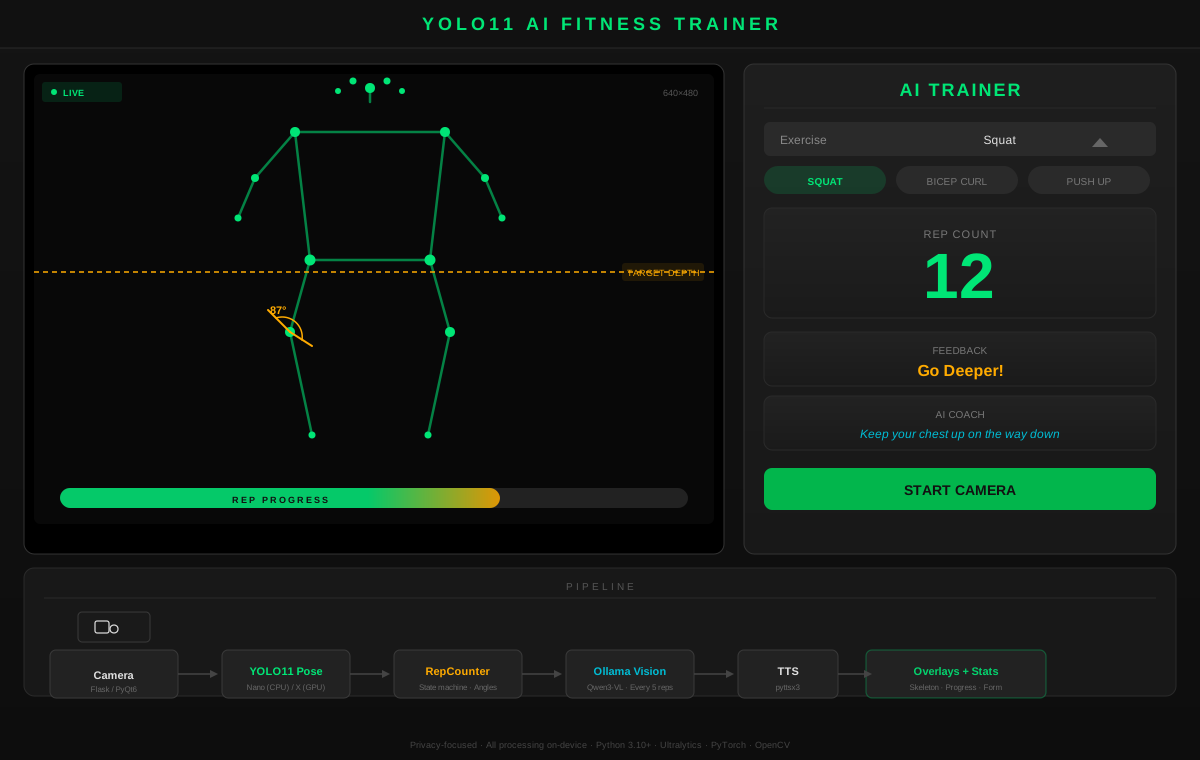
Problem
Most fitness tracking applications count repetitions using timers or accelerometer heuristics — they cannot evaluate whether the user is performing an exercise correctly. Good form feedback traditionally requires a human coach, which is expensive, inaccessible, and not available on demand. Meanwhile, cloud-based AI pose estimation services raise privacy concerns around streaming bedroom or living-room video to third-party servers.
Approach
I built a browser-based and desktop-local fitness assistant that runs entirely on-device, with no cloud dependencies. The system uses a webcam feed, YOLOv11 pose estimation, exercise-specific geometric logic, and a local vision language model to provide form-aware rep counting and coaching.
The architecture is split into four layers:
- Capture: Camera input via browser
getUserMedia(web) or OpenCV (desktop) streams frames to a Flask-SocketIO backend or directly to a PyQt6 video thread. - Pose Inference: YOLOv11 extracts 17 body keypoints from each frame. The system automatically selects the full-accuracy
yolo11x-pose.ptmodel when CUDA is available, and falls back to the fastyolo11n-pose.ptfor CPU-only systems. - Logic:
RepCounterstate machines use 2D vector geometry — computing joint angles via dot-product — to detect rep transitions and flag form issues for squats, bicep curls, and push ups. Dual-arm tracking for curls includes hysteresis logic to prevent flickering between arms. - AI Coaching: Every 5 completed reps, the current frame is sent to a locally-hosted Ollama instance running Qwen3-VL, which returns a one-sentence form tip. Feedback is spoken aloud via pyttsx3 text-to-speech.
Technical Decisions
- Flask + SocketIO serves the web frontend with real-time bidirectional frame exchange. The browser captures frames at ~10 FPS via canvas snapshots, sends them as base64 JPEGs, and receives annotated frames with skeleton overlays, depth target lines, and a progress bar.
- PyQt6 provides an alternative native desktop UI sharing the same
VideoProcessorbackend, with exercise selector dropdown, large rep counter display, and live feedback labels. - Dual-arm hysteresis for bicep curls uses a ±20° bias toward the last active arm, preventing rapid toggling when both arms are visible and at similar angles.
- Privacy by design: camera feed, YOLO inference, angle calculations, LLM calls, and TTS all stay on the local machine. No data leaves the device.
Result
The project demonstrates practical integration of CV inference, local LLM calls, browser camera workflows, and real-time user feedback — all within a privacy-preserving local architecture. The codebase supports two front-end modes, automatic GPU/CPU model selection, and three exercises with distinct state-machine rep counting logic.
Tech stack: Python 3.10+, Ultralytics YOLOv11, PyTorch, OpenCV, Flask, Flask-SocketIO, PyQt6, Ollama + Qwen3-VL, pyttsx3.